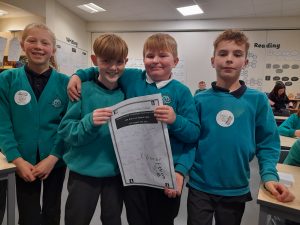
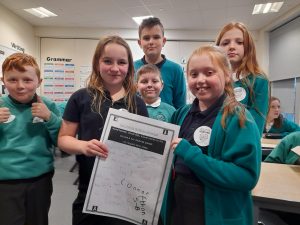
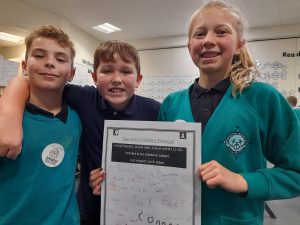
Year 6 Science Exploring Circuits

Previous learning has taught the children a circuit always starts with a battery (a cell) . A flow of electricity moves from the positive pole to the negative pole of the battery. The flow is pushed by the battery, through the wires to the other components in the circuit. This makes a complete electrical circuit.

The first challenge was to create a simple circuit…
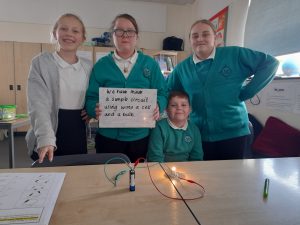
We made a simple circuit using wires, a battery and a bulb…
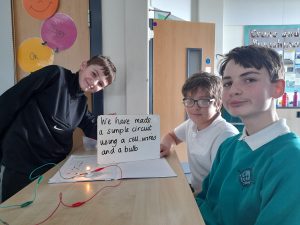
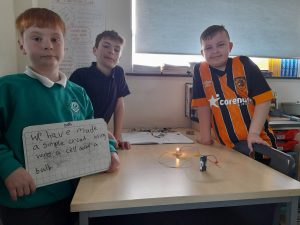
 

Then the all important question..

How can we increase the brightness of the bulb ?

Time to put your scientific heads on!!! Lots of discussion; lots of hypothising, ideas and theories began to develop.Obviously, as every scientist knows, these ideas and theories need to be tested .

Then the light bulb moment !!!

By increasing the voltage we also increased the brightness of the bulb….
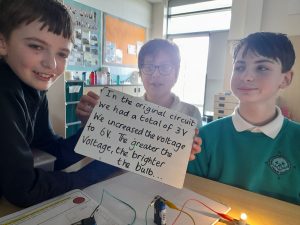
In the original circuit we had a total of 3V…we increased the voltage to 6V. We discovered the greater the voltage the brighter the bulb.
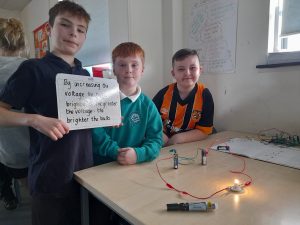
The greater the voltage the brighter the bulb

Then an extra challenge.

How can we make a switch out of foil and cardboard,  which will open and close so we are able to switch the bulb on and off?
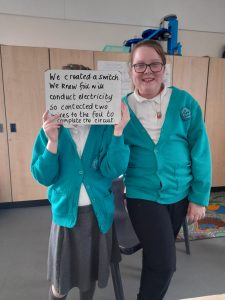
We created a switch , which would open and close. We knew foil would conduct electricity. We connected the wires to each end of the foil to create a complete circuit.

Well done girls!!!


Year 6 Science Static Electricity

Year 6 had lots of fun investigating static electricity.

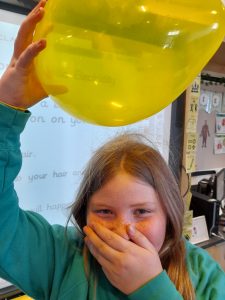
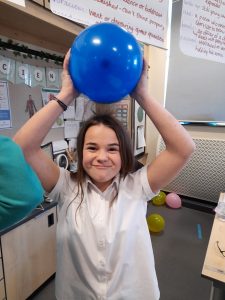
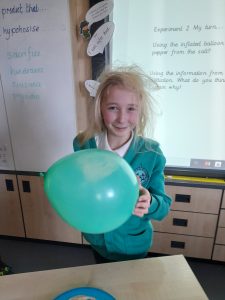
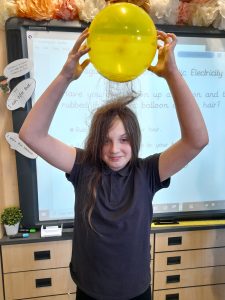
Static electricity is the buildup of the electrical charge in an object when it is rubbed against another object. Static electricity causes objects to stick together when they have opposite charges and repel when they have the same charge. Common examples of this include rubbing a party balloon on your head.

We thought we’d give it a go…

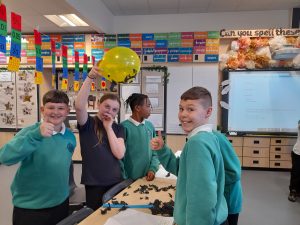
We had some enthusiastic volunteers…

Loving the new hairstyle…


Some objects such as wool, glass, human skin and hair are more likely to accumulate electric charges and have static electricity. Shuffling your feet across carpet, particularly in socks, is another way your body gains more electrons; they are released when you touch something such as a doorknob or another person.

As scientists the children were  posed with a problem.

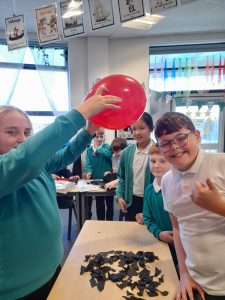
How could they get tissue paper to move without touching it ?

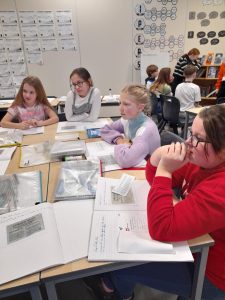
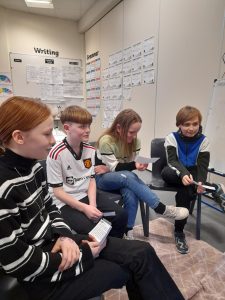
Working systematically and collaboratively small groups carried out their investigation…

Getting there…

How could we attract more tissue paper?

This group were more successful….

They realised rubbing the balloon for different lengths of time to hold different amounts of static electricity to pick up more tissue paper worked.

And finally making a prediction….

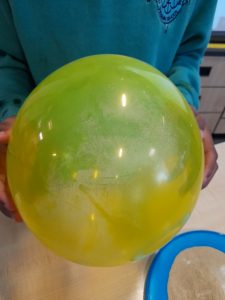
What will happen if you rub a balloon on your head a hold it over a mixture of salt and pepper?

The science explained…

It’s not magic, it’s static electricity! Rubbing a balloon gives it a negative charge, also called static electricity. When the balloon gains enough static electricity, and it is brought near the mix of salt and pepper, the negative charge polarizes the salt and pepper. That is, it moves the electrons of the salt and pepper to one side, leaving one end positive and one end negative. The positive end is attracted to the negatively charged balloon, but because pepper is much lighter than salt, the pepper flakes will jump on the balloon, leaving the salt behind.


Static electricity does more than just make your hair stand up!!!

Mental Health Week Y6


Every year , Children’s Mental Health Week takes place during February.  This year the theme is,

‘ Let’s connect’.

Connecting with others helps us to share experiences with people we trust and care about. Positive relationships give us opportunities to share our feelings and get someone else’s views on what we are experiencing. Positive relationships give us a sense of feeling and belonging.

The BIG QUESTIONS:

What is mental health?

How can we look after our own mental health?

How can we look after the mental health

of others ?

What can we do to keep our minds healthy?

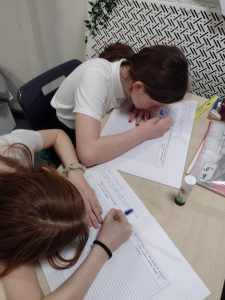
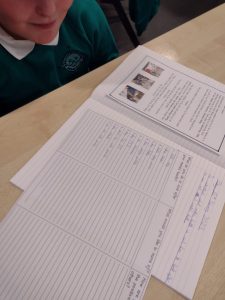
After lengthy discussions the children were asked to come up with a Mental Health Action Plan…

And when all the hard work is done – chill time – with a purpose!

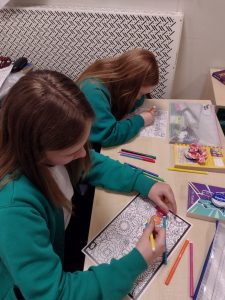
Colouring is a healthy way to relieve stress. It calms the brain and helps your body relax. This can improve sleep and fatigue while decreasing body aches, heart rate, respiration, and feelings of depression and anxiety.

A perfect way to end the day.

PSHCE YEAR 6


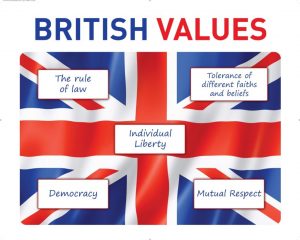
What are British Values?

Fundamental British Values underpin what it is to be a citizen in a modern and diverse Great Britain valuing our community and celebrating diversity of the UK. These values are Democracy, Rule of Law, Respect and Tolerance, Individual Liberty.

Why are the 5 British Values important?
We see British Values as underpinning what it is to be a citizen in a modern and diverse Britain. They allow us to create environments free from discrimination, intolerance and hate. They help us to challenge prejudice and stereotyping, whilst strengthening relationships within the community.
As part of our PSHCE/JIGSAW Lesson Year 6 discussed how
these values are clearly evident throughout our school.
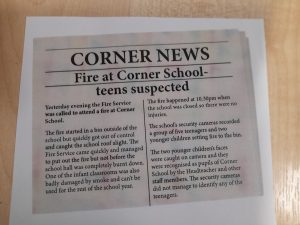
Then the children were given a scenario of an event that could happen…
Once the children had read the the news report  they took on the roles of the adults who were directly involved.
These included: a police officer, a fireman, the headmaster of the school, the class teacher and the parents of some of the children involved.
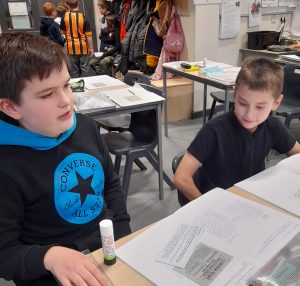
They had to  listen carefully to the views and opinions of  all members of the group.The right to free speech – individual liberty . It was necessary to show respect and tolerance eventhough their views and opinions differed greatly. 
They had to abide by the rule of law when it came to important decision making…
Finally, as part of tte democratic process , they had  to decide what steps needed to be taken so that every member of the group was happy with the final outcome .

Year 6 Art Banksy Style

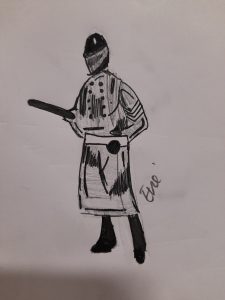
Year 6 have been learning about one of Britain’s most influential modern –  day artists,  the graffiti famous Banksy. His artwork appears in public places as if by magic.  Eventhough his identity has never been revealed his work is instantly recognisable as he has a particular style.

We looked at lots of examples of Banksy’s work which encouraged the children to think deeply about the hidden meanings in pieces of art.

There is a common misconception that graffiti is something that has only appeared in modern day culture. However, this is not the case as forms of graffiti can be traced back to ancient times in places such as Rome and Greece.

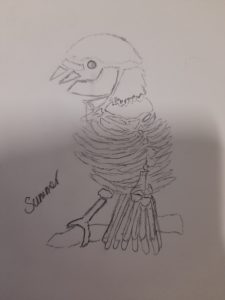
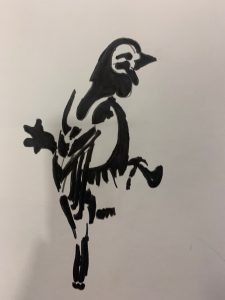
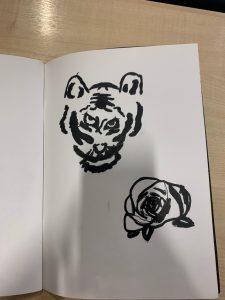
To build confidence the children created pencil sketches…

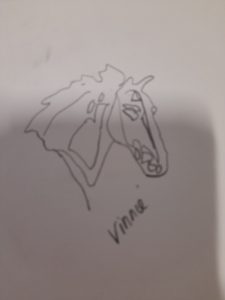
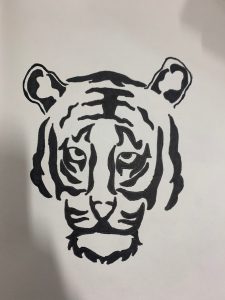
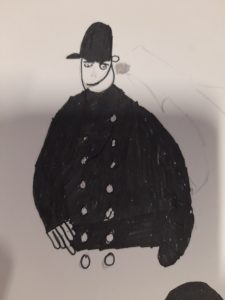
Then the drawings were outlined in fine black marker pen to add detail…

Then permanent marker was added to add blocks of colour – creating a stencil effect – just like Banksy…

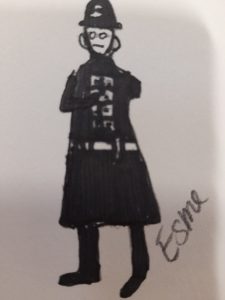
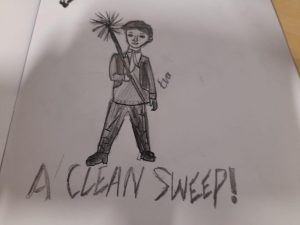
Some of our children preferred to remain anonymous…just like Banksy…


Then we linked the artwork to our history topic, Crime and Punishment…


And finally ….in true Banksy style…

                                              Eva


Learning about varied forms of art work will inspire children to think about what artistic style they would like to adopt themselves.


Year 6 Crime and Punishment

Our Year 6 history curriculum provides a platform to enrich children’s awareness of the past and develop their historical consciousness. Our curriculum builds on pupils’ understanding of British, world and local history, looking at the influence that Britain had on the wider world, and how the wider world has influenced Britain.

The latest History topic for Year 6 is ‘Crime and Punishment ‘.

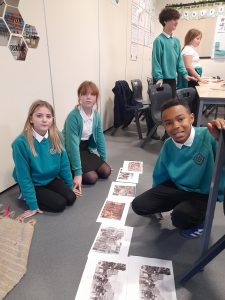
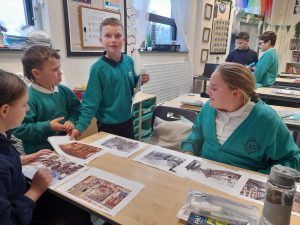
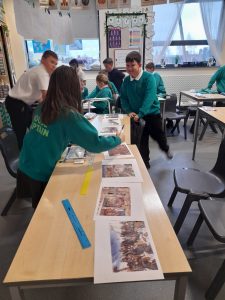
For the first lesson the children were given the task of arranging historical events in chronological order.

Chronology is the science of locating historical events in time. It relies upon chronometry, which is also known as timekeeping, and historiography, which examines the writing of history and the use of historical methods.


Looking for the evidence…


Logical thinking…


Historians heads on…

Searching  for clues…

Making decisions….

Why are timelines important ?

 A timeline is a visual learning aid that helps children organize a series of events in the order they happened. Each event or person should have a date (or time) clearly marked on the timeline. Timelines provide a framework to show potential relationships between historical events.


Year 6 Chocolatiers

Year 6 have been thinking about the 3P’s in their Design and Technology unit of work.

Design and make a Product for a Person with a Purpose

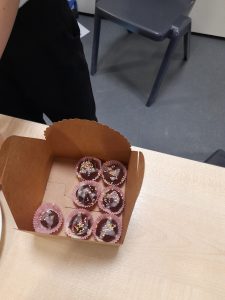
As technologists Y6 were challenged to design chocolate truffles that were to be a gift.


DT is not just about ‘making’. There are lots of steps that come before and after that !

Investigate – Learning about existing products

Focused Practical Task – Practising vital skills

Design – Designing a range of possible products

Make – Making the product

Evaluate – Looking back on what you did and considering what went well, what didn’t go so well and thinking about what you would have done differently

Our Learning Journey took us through each of these stages.

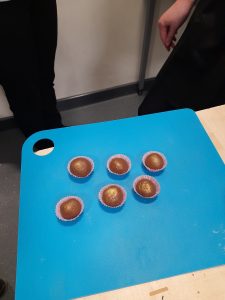
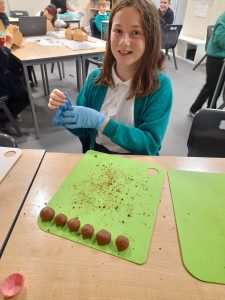
For two weeks the children were challenged to be chocolatiers.


Work in progress!!!
       

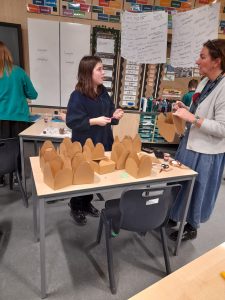
Now time to decorate !!!!              Preparing the packaging!!!
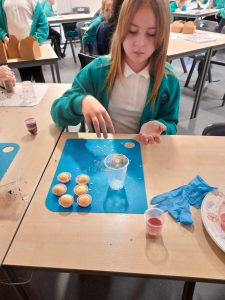
                     !                                                                           
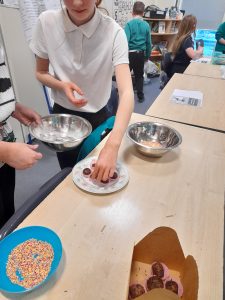
 

Nearly there!!!


What a professional looking finish !!!

Year 6 White Ribbon

White Ribbon Accreditation ensures organisations take a strategic approach to ending male violence against women by engaging with men and boys, changing cultures and raising awareness. With this years theme being “Let’s Be The Change” , the focus is to create meaningful change through conversations and education, with the goal to end all forms of violence and abuse .

Year 6 were all happy to sign Our White Ribbon Promise.

Kind Hands,

Kind Feet,

Kind words to all.

We are a non violence school.

We respect each other.


We also had a very lengthy discussion about different ways in which we could offer help ,  if we were approached , by someone who had been a victim of abuse.


Year 6 Baking Mad !!!

Having an easy go to cupcake recipe will help you out at various different occasions throughout the year!

Cupcakes are usually one of the first recipes that novice bakers learn to make, whether that is as a child, or as an adult. Cupcakes are really easy to make from scratch, they require very few ingredients and are super simple to make.

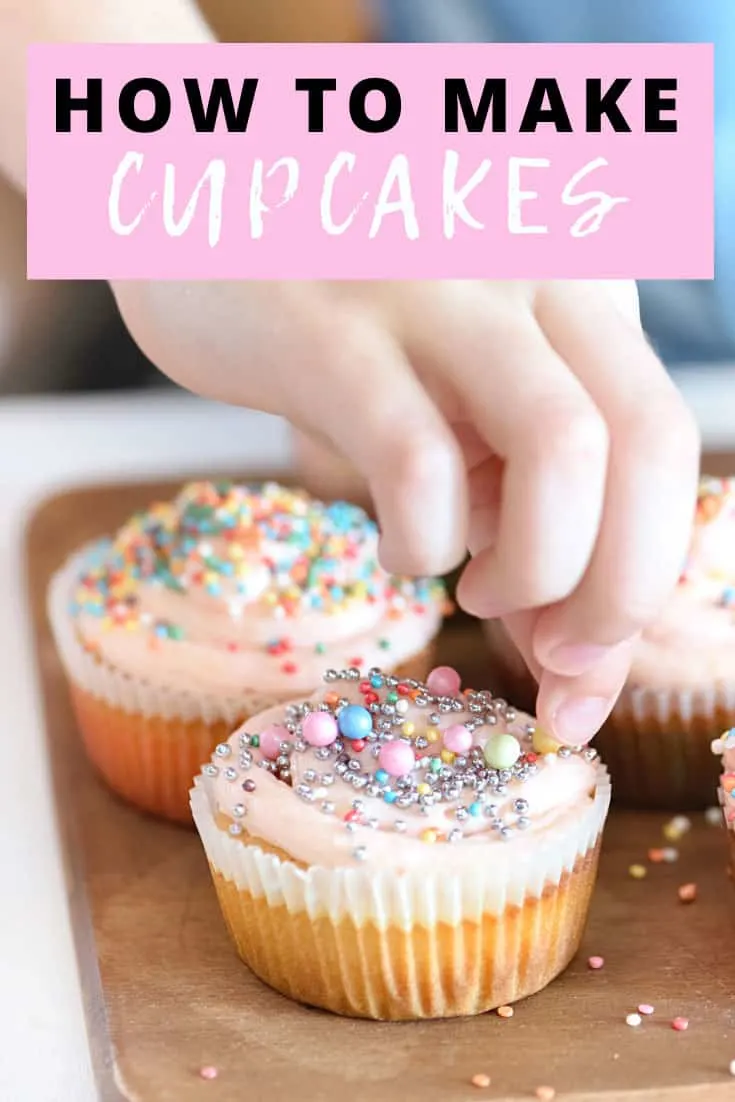
decorating cupcakes with sprinkles

How To Make (Easy) Cupcakes From Scratch

If you follow this method for making basic cupcakes you’ll have great results. This is an easy  recipe to use to encourage children to get baking.

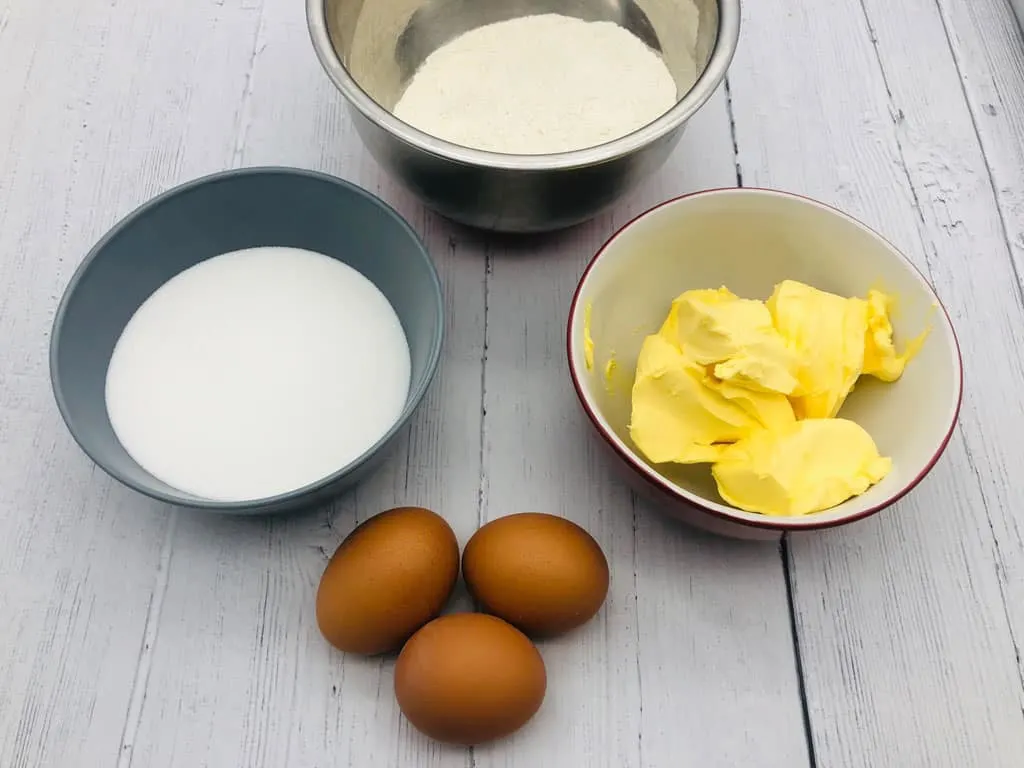
ingredients for cupcake recipe

It’s a really easy list of ingredients to remember for this cupcake recipe:

  • 125g caster sugar
  • 125g butter, softened (or margarine)
  • 125g self raising flour
  • 2 large eggs (don’t know why there are 3 in the picture)
  • 1tsp vanilla essence

The best way to get GREAT results are to mix the ingredients step by step;

  1. Preheat oven to 180C/160C fan/gas 4
  2. Cream the butter, sugar and vanilla extract together in a bowl.
  3. Add the eggs and flour (sift the flour in).
  4. Beat everything together until the mixture is smooth. If you are using an electric whisk or stand mixer be careful not to over mix or the texture of the cupcakes will come out too dense.
  5. Use a tablespoon to half fill each case with the cupcake mixture. You may need to use a teaspoon or knife to help scrape all the mixture off.
  6. Bake in oven for 20 minutes.
  7. When the cupcakes are ready they will have risen and be a golden brown colour. If in doubt, check they are cooked though by inserting a metal skewer/cocktail stick and checking if it comes out dry.

And that’s how easy it is!

Just out of the oven- we need to let them cool before icing!!!


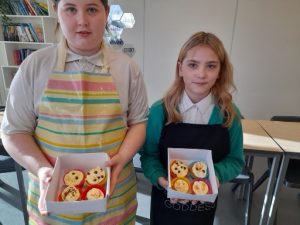
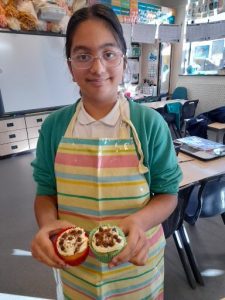
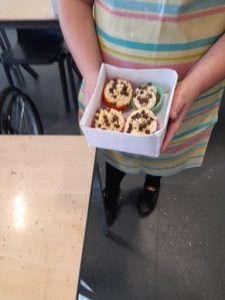
The children can hardly wait. All they need now is an expert finish.


We may have found some future British Bake Off contestants!!!


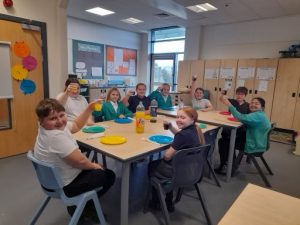
The children had lunch together on Wednesday: pizza , garlic bread, juice.

Wonder what was on the menu for dessert???