Year 1 – RE

Year 1 have been thinking about “how values provide rules for living”… but first we needed to find out what values actually were.  

“Values are group of things that are important – such as honesty, good manners, kindness, determination.”

Many values come from holy books, like – the Bible which is a sacred text. 

We looked at 10 Commandments last week and this week we listened to the story of The Good Samaritan, which is a story from the Bible. 

The children were shocked that people just walked by the injured man, and that the good Samaritan (although he had different beliefs) was the only one to help.

We discussed hat we would do and how we would always help others when needed, it is important to remember that although we may have different beliefs and different gods, places of worship and bibles – we should be kind to everyone regardless of this. 
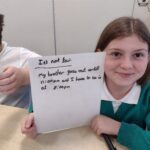


YEAR 6 RE – JUSTICE AND FREEDOM: IS IT FAIR?

In Year 6 this term, we have contemplated the times that we all say…

‘IT’S NOT FAIR!’

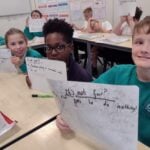
It all started with Miss Stewart treating just a few children to chocolate treats, dojos and special privileges, whereupon it was not long before many children became disgruntled and called out ‘IT’S NOT FAIR!’  We then had a class discussion as to why some children felt the injustice of Miss Stewart’s actions before everyone realised that it was all part of the planned lesson.

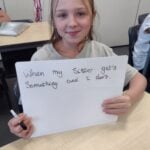
We then had the opportunity to share some of the injustices that we believe are not fair in our own lives…

From this, we then undertook a philosophical debate on the injustices specific groups and communities may feel within society today today…

Race
Gender
Religion
Disability

We established that whilst the trivial things in our own lives may not seem fair to us, that all people should be treated equally and with the fairness and respect that they deserve to ensure that there is justice and freedom for all in the world that we live.

To clarify – In order to make it fair…Miss Stewart did ensure that all children received a chocolate treat and a number of dojos!


YEAR 5 R.E – EXPRESSIONS: HOW IS BELIEF EXPRESSED?

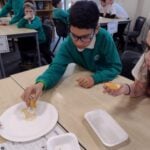
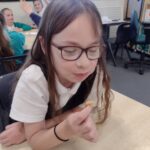
This term the children in Year 5 have been exploring the ways in which people of faith express themselves.  Through observation and discussion, we have identified that clothing, symbols, religious rituals, ceremonies and worship practices allow a person of faith to express themselves, their identity as well as their devotion to their faith.  We then made comparisons in the way Autumnal religious festivals (Harvest, Diwali and Rosh Hashana) foster a sense of community, belonging and pride within faith groups. As a tasty treat, we tasted one of the traditional foods eaten during the Jewish festival of Rosh Hashana, which celebrates the beginning of the Jewish New Year in the Hebrew Calendar.

‘Apples and Honey’ symbolise the hopes for a sweet and prosperous New Year.

Year 1 – RE

We have been looking at rules and why we need them.

We discussed that rules keep us safe and make sure that everyone is treated fairly.

The children shared their family rules.  Forrest told us that in his house they’re not allowed drinks in bed and Matilda told us that in her house no outdoor shoes are allowed.  We realised that all families don’t always have the same rules.

Myles told us that “we have golden rules at school” and we all agreed that these rules can also be used in family and a sports clubs. 

We then listened to the story of Moses and how God gave him the 10 Commandments.

The commandments were the rules for all people to follow and live a good life by.

When we looked at the 10 commandments, the children could understand their importance in life today, even though they were from the Bible that was written a long, long time ago.

Year 1 then designed a poster of a rule which was most important to them. We decided that ‘be kind’ and ‘always try your best’, were the most important rules to follow.

Y1 – RE

Year 1 have previously looked at what belonging and faith means to ourselves and others.

We have discovered that there are different religions, with different gods, different places of worship, different festivals and different rituals.

Year 1 have already learnt that Christian’s celebrate Jesus’ birth on Christmas Day, so this week we looked at two different festivals from different faiths.

The Hindu festival of Holi –

  • Holi is a festival celebrated by Hindus and it takes place in March.
  • It marks the start of spring and is sometimes known as the Festival of Colour. It celebrates good winning over evil.
  • Everyone chases each other with dry powder paint and coloured water.
  • People sing, dance and have fun together, no matter who they are.
  • Bonfires remind people that the winter days are coming to an end and warmth and light are coming.

The Muslim festival of Eid –

  • Eid is a festival celebrated by Muslims and it takes place at the end of Ramadan.
  • During Ramadan grown-ups do not eat or drink anything while the sun shines.
  • People put on new clothes and share meals with family and friends.
  • Homes are decorated, their sacred text, the Qur’an, is read and they go to the mosque to pray.
  • Some women and girls decorate their hands with mehndi patterns.

Year 1 – RE

“What is it like to be in a faith family?”

Year 1 looked at ‘a day in the life’ of a Christian and a ‘Muslim’ child.

Then we shared our thoughts on their similarities and differences.

Both prayed but had different places of worship, a Christian church and a Muslim mosque.

Both have sacred texts – the Christian bible and the Muslim qur’an.

We discussed how belonging to our family, school and clubs makes us feel special and cared for, and that being part of a faith would make you feel that way too.


Year 1 – RE

Last week, Y1 looked at what the word belonging means.

We discovered that we might belong to schools, families and groups…some of us belong to different clubs, but we all belong to Christopher Pickering Primary School.

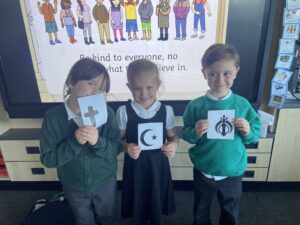
This week we looked at different faiths that people can belong to… Christian, Muslim and Sikh and we looked at the symbols that represent them.  We found out that different faiths all have different places of worship and different Gods that they pray to.

We discussed the Christian church, Skyla goes to church with her family on a Sunday and they “sing songs and pray”, Matilda knew that “Jesus died on a cross”, and Forrest remembered that “he came back to life a couple of days later”.

Ivan was able to share with us that he is a Muslim, “my family are all Muslims too”.

We looked at different places of worship, the children thought the Muslim mosque  looked very fancy, some recognised a Christian Church and we discovered that Sikhs worshiped at a Gurdwara.

We spoke about praying, Thomas knew that “Mrs. Marson says a prayer at the end of assembly, we put our hands together and close our eyes”.

We also looked at clothing that different faiths wear, learning that Sikh boys cover their heads with a Romala and that Muslim girls wear a Hijab.

We looked at the similarities and differences between different faiths. The children discovered that both Christian and Sikh children have places of worship where they can go to pray to their own God.

People may have different beliefs and Gods that they worship, we may wear different clothes and pray in different ways in different places, but everyone is special.

Y1 – RE

Year 1 have been thinking about what the word belonging means.

We might belong to schools, families and groups, such and swimming, rugby or Rainbows.  We looked at the different symbols that represent these…some of us belong to different clubs, but we all belong to Christopher Pickering Primary School.

Thomas said “at football we all have the same Tigers badge because we belong to that club”.

We found out that belonging is “a feeling of safety, support, acceptance and inclusion at being a member of a group”.

All of the children agreed that belonging to a group made them feel special and happy.


Buddhist Visit…

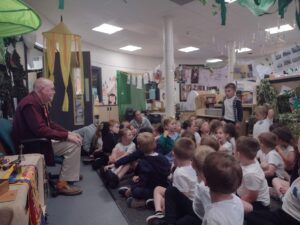
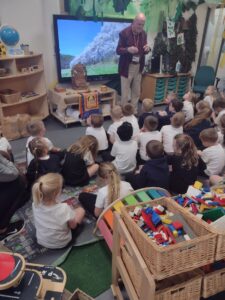
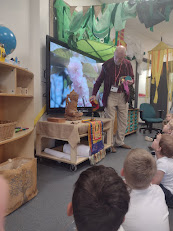
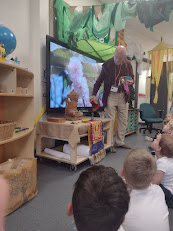
Foundation Stage had a special visitor this week…Neil from the local Buddhist Centre… 

Our visit was very interesting and we had some fabulous questions to ask Neil!

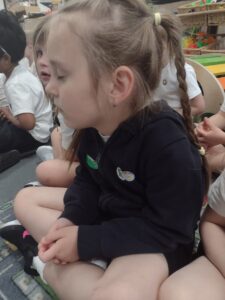
We have being learning all about the religion and practice of Buddhism and what they believe and how they celebrate this. Neil brought lots of things in for us to look at… we particularly liked the singing bowl, which helped to start and finish our meditation…this we found very relaxing!

“Who was Buddha?” “What did he teach?” “Why is Buddha called Buddha?”


RE

Where do sacred stories come from?

During this lesson the children learned the meaning of the word ‘sacred’ which is a religious kind of ‘special’.  We learnt that different religions have sacred texts which include great stories in them, that are shared within their community. This is so people learn the importance of being kind, respectful as well as having a sense of belonging.


I reminded the children of our school’s RESPECT values:-

          Resilient, Enthusiastic, Safe, Perseverance, Empathetic, Confident and Tolerant.                We discussed the meaning of each of these values and how these are common themes throughout the stories we read as a class.


Image preview


Image preview

The first story we looked at was the Christian story ‘The Good Samaritan’. The children knew that this story could be found in the bible and enjoyed learning about this.

The next story we looked at was the ‘The crying camel’ which is an Islamic story found in the Quran. Arios said he loved learning about this story because he is Muslim and reads the Quran at home.

The final story we looked can be found in the Torah which was ‘The story of Moses’. This is a Jewish scared story.

The children could easily identify which symbol and story belonged to each sacred book.