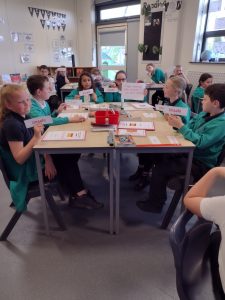
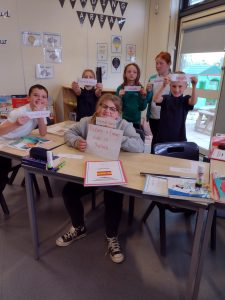
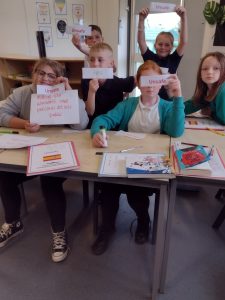
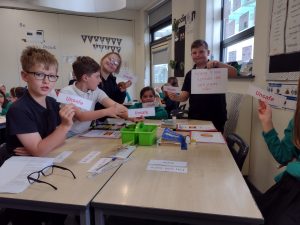
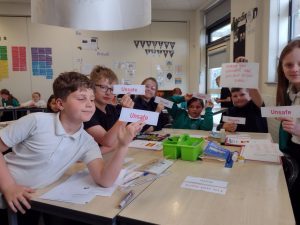
In today’s PSHCE lesson, year 5 had a discussion about how to stay safe online and the positives and negatives of an online community. We played the ‘online safety’ game: Each child had three cards, one labelled ‘safe’, one ‘unsafe’ and one ‘I’m not sure’.
The teacher read out different statements and the children made decisions, using their cards to show the class their answer.
Some of the statements were both safe and unsafe depending on the context, so we used this opportunity to explain that being online can have good/bad/positive/negative consequences.
Easier statements:
- Sending a picture of yourself to your Mum/Dad/Gran
- Texting a happy emoji to your friend
- Sending someone an unkind message
- Snap chatting with someone you don’t know
- Watching a children’s TV programme online that a trusted adult has found for you
- Playing a puzzle game online and answering a message from somebody else playing who you don’t know
- Posting your phone number online so anybody can see it
- Joining in with something online that someone says is a secret
Harder statements:
- Playing a computer game with a 16-age limit
- Joining a social network about a favourite sport or hobby
- Sending a picture of yourself in your underwear
- Joking about someone’s appearance in a text
- Making your gaming username and personal details public
- Keeping an online ‘streak’ with a friend going for 200 days or more
- Posting a funny video of a cat playing the piano on Youtube
- Chatting live to an online gamer who has just joined in with your game
- Agreeing to have a private chat with someone online
Year 5 were able to share their thoughts and feelings on each statement; the lesson was extremely useful for the pupils to learn and adapt their knowledge of online safety.